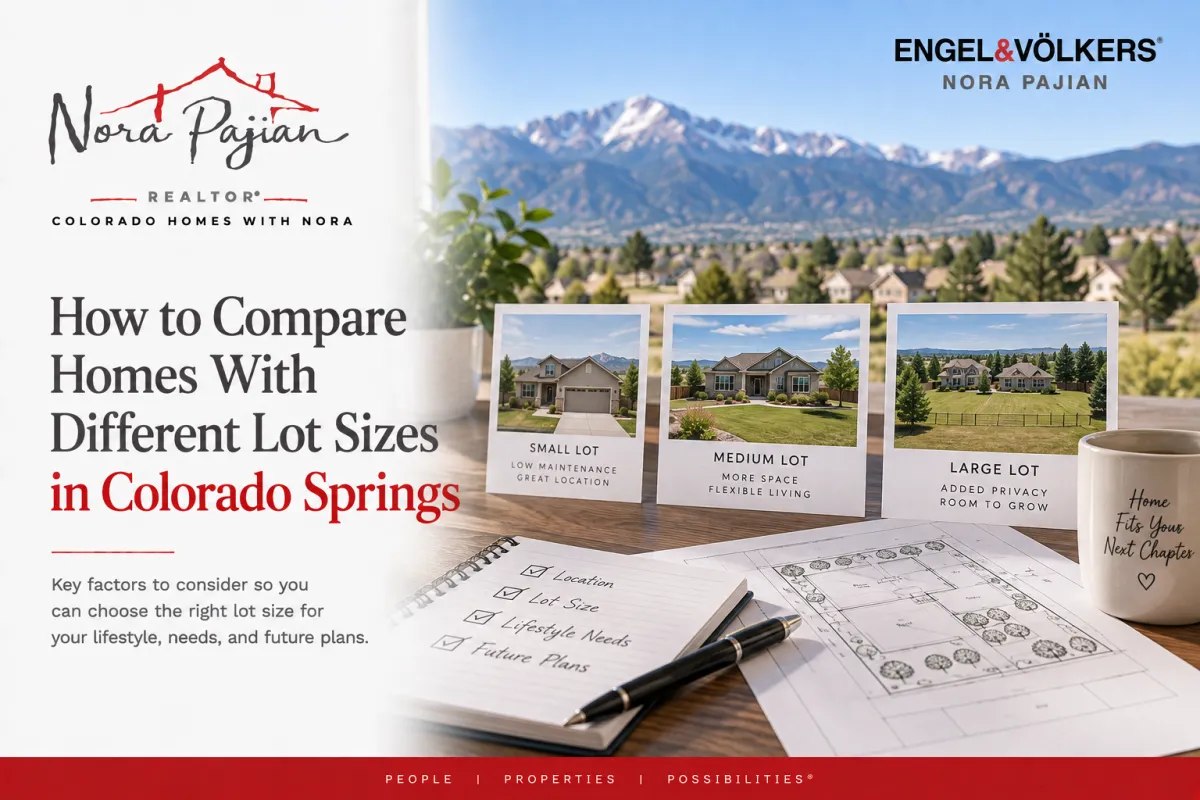
How to Compare Homes With Different Lot Sizes in Colorado Springs
When comparing homes in Colorado Springs, the size of the lot can be just as important as the size of the house. A larger lot may provide more outdoor space and privacy, while a smaller lot can mean less maintenance and potentially lower landscaping costs.
The right lot depends on how you plan to use the property, your budget, and how much outdoor maintenance you're comfortable managing.
Start With How You Plan to Use the Lot
Before comparing lot sizes, think about what you actually want from your outdoor space.
Do you want room for a patio, garden, play area, outdoor entertaining, additional parking, or simply more open space? Your intended use can help determine whether paying for additional acreage or yard space makes sense.
Why this matters:
A larger lot isn't necessarily better if you don't plan to use the additional space.
Look Beyond the Total Square Footage
Two lots with the same overall size can have very different layouts.
Pay attention to the shape of the lot, where the home sits, usable yard space, slopes, landscaping, fencing, and access to different parts of the property.
What to do:
Look at the actual usable outdoor space
Consider the lot's shape and topography
Check where the driveway and structures are located
Think about how furniture, landscaping, or other improvements could fit
Consider Maintenance Requirements
A larger lot generally means more property to maintain.
Depending on the property, maintenance may include lawn care, landscaping, trees, fencing, irrigation, snow removal, and other exterior upkeep.
Why this matters:
A larger lot can provide more flexibility, but it may also require more time and money to maintain.
Think About Privacy and Surroundings
Lot size can influence how much space exists between your home and nearby properties, but it isn't the only factor.
The home's position on the lot, surrounding properties, fencing, landscaping, natural features, and nearby open space can all affect how the property feels.
When touring a home, look beyond the backyard and consider the entire setting.
Check Zoning and Property Restrictions
A larger lot may appear to offer opportunities for additions, detached structures, landscaping projects, or other improvements. However, not every idea will necessarily be permitted.
Before purchasing, review applicable zoning requirements, setbacks, easements, HOA rules, and other restrictions.
Why this matters:
The size of a lot doesn't automatically determine what you can build or change on the property.
Compare the Total Cost of Ownership
When comparing two homes with different lot sizes, don't focus only on the purchase price.
Consider property taxes, landscaping, irrigation, utilities, insurance, maintenance, and potential improvements.
A home with a smaller lot may have lower ongoing maintenance requirements, while a larger lot may provide features that are worth the additional expense to you.
Consider Colorado Springs' Terrain and Climate
Colorado Springs properties can have varying terrain, from relatively level lots to properties with slopes or other elevation changes.
Seasonal weather can also affect landscaping, drainage, irrigation, and snow removal.
A larger lot isn't necessarily more useful if portions of it are difficult to access or maintain.
Compare Similar Properties
When you're deciding whether a larger lot is worth the additional cost, look at comparable homes with similar locations, sizes, and features.
Your Realtor can help you compare properties and understand how differences in lot size, location, condition, and amenities may affect the overall value.
Common Mistakes Buyers Make
Assuming a larger lot is always better
Focusing only on total lot square footage
Overlooking difficult-to-maintain areas
Assuming a larger lot can automatically be developed
Forgetting about landscaping and maintenance costs
Not considering the home's position on the lot
Frequently Asked Questions
Is a larger lot always more valuable?
Not necessarily. Lot value depends on factors such as location, usability, shape, topography, zoning, surrounding properties, and market demand.
What should I consider besides lot size?
Look at the lot's shape, usable space, terrain, privacy, landscaping, access, restrictions, and maintenance requirements.
Are larger lots more expensive to maintain?
They can be. Larger properties may require more landscaping, irrigation, fencing, snow removal, and general upkeep.
Can I build anything I want on a larger lot?
No. Zoning regulations, setbacks, easements, HOA requirements, permits, and other restrictions may limit what can be added or changed.
How can I compare two homes with different lot sizes?
Compare the homes based on the total property, including the house, usable land, location, condition, amenities, ongoing costs, and potential uses of the lot.
Key Takeaways
The largest lot isn't always the best fit.
Consider how much outdoor space you will actually use.
Look at usable space, terrain, layout, and privacy—not just square footage.
Factor maintenance and ongoing costs into your decision.
Verify zoning, easements, and other property restrictions.
Compare similar properties to understand whether the additional lot size is worth the cost.
Looking for the Right Home and Lot in Colorado Springs?
The right property isn't necessarily the one with the biggest lot. It's the one that provides the space, functionality, location, and ownership costs that fit your needs.
Nora Pajian, a Colorado Springs real estate agent with Engel & Völkers, can help you compare properties and evaluate how differences in lot size may affect your home-buying decision.
👉 Reach out today to start your Colorado Springs home search.